If you've ever held one of our 10-pound bags up to the sun, you've already had the conversation we have with new customers a dozen times a week: why is this ice so clear? The answer is part chemistry, part patience, and part stubbornness about doing things the long way when the short way is right there.
Here's the short version. Ordinary ice freezes from every direction at once. The freezer in your fridge surrounds the tray, the cold sneaks in from the top, the bottom, and the sides, and the water locks up before it has time to think. Anything dissolved in that water — minerals, gases, the tiny bits of whatever the city pipes carried over from the treatment plant — gets trapped right where it was when freezing started. That's why the cube you pulled from your tray this morning has a foggy white core. That center is the last bit of water to freeze, and it's where every impurity in the cube has been pushed and locked together. It's not dirty. It's just disorganized.
Slow-freezing is the opposite philosophy. We freeze our blocks directionally — cold from one face, insulated everywhere else — over many hours. Water freezes top-down (or bottom-up, depending on the rig), and as it does, it physically pushes dissolved solids and dissolved air out ahead of the freeze line. By the time the block is finished, the impurities have been driven all the way to the unfrozen tail end, which we cut off and discard. What's left is a slab of ice that's almost optically pure: glass-clear, dense, and quiet.
That density is the part most people don't expect. Clear ice isn't just prettier — it's denser, because it has fewer trapped air bubbles. Fewer bubbles mean less surface area exposed to your drink. Less surface area means slower melt. A 2-inch clear cube in an old-fashioned will outlast two or three cloudy ones, and it'll dilute your bourbon at a rate the bartender actually planned for instead of a rate dictated by whatever came out of the ice machine that morning.
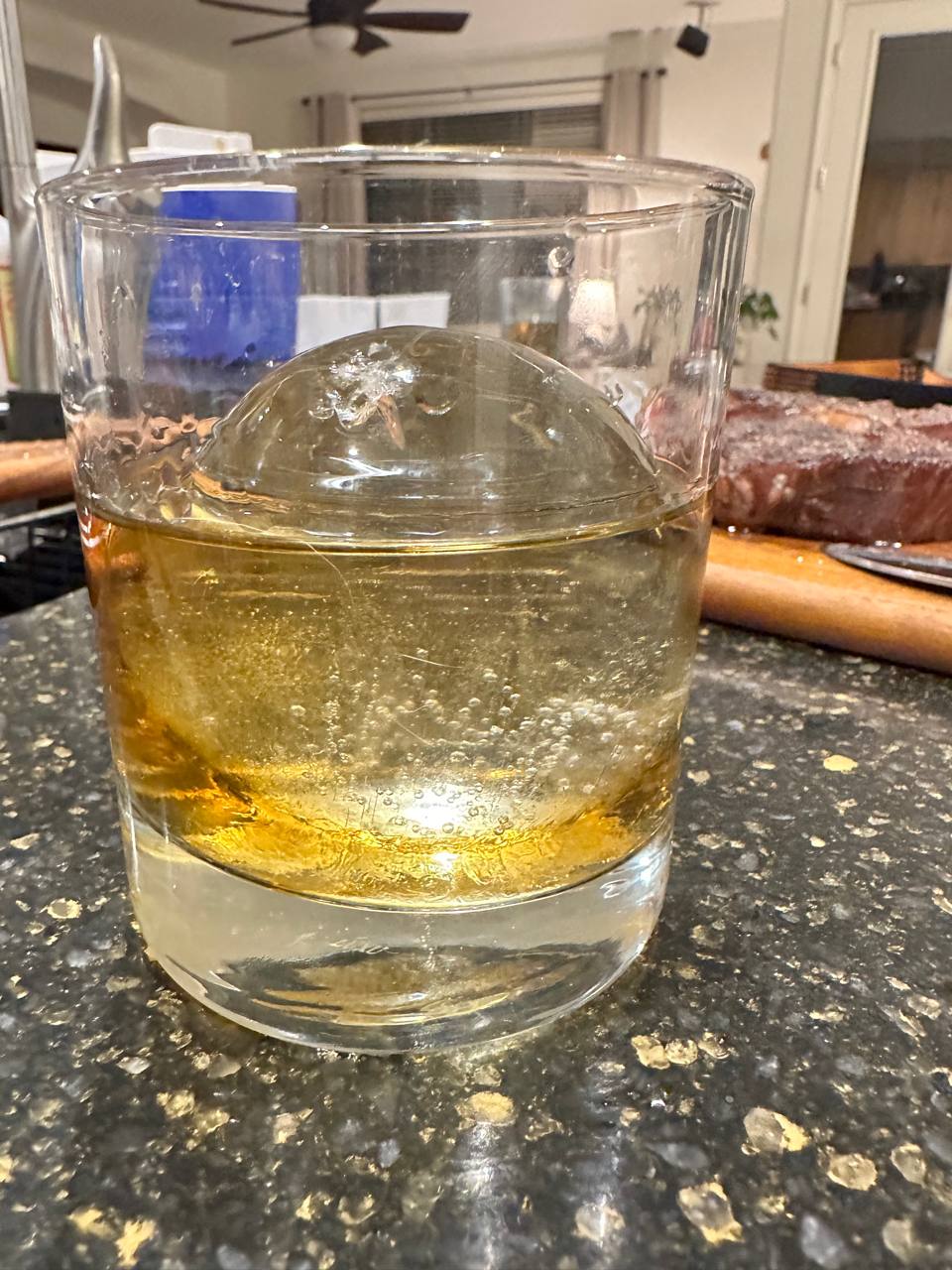
That's one of ours, in someone's glass at home, on a steak night. Notice the sphere — no cloudy core, no white center. That's what slow freezing looks like in a finished cube.
Bartenders figured this out a decade ago, and the good ones haven't shut up about it since. If you've sat at a craft cocktail bar in Phoenix or Scottsdale and watched the bartender drop a single perfect cube into a Negroni, that's clear ice doing its job — keeping the spirits cold without watering them down before you've taken three sips. We sell to a handful of those bars. We also sell to the bars that want to look like that and don't have the freezer space or the labor to cut their own.
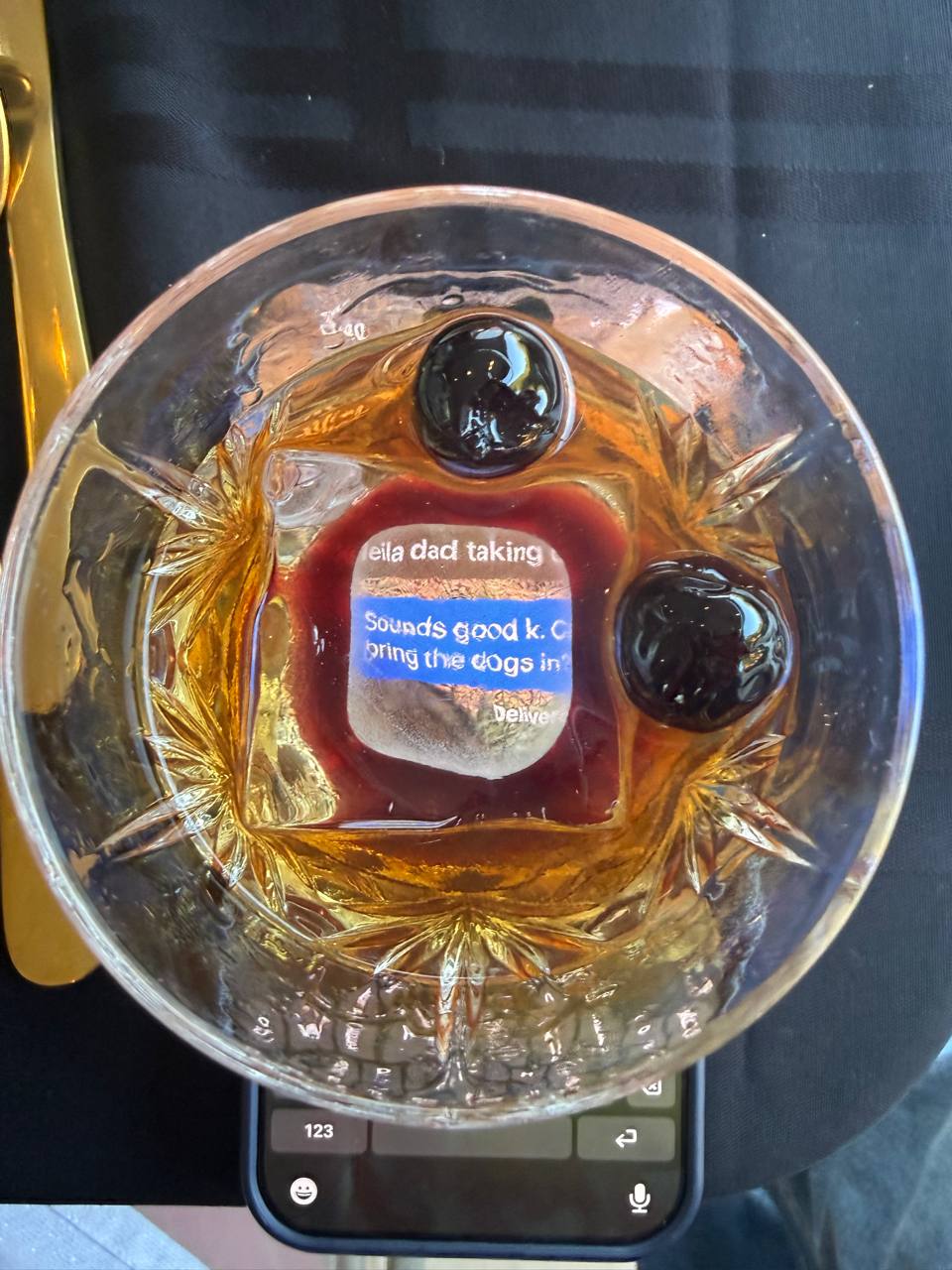
A 2-inch cube, two Luxardo cherries, a star-cut rocks glass. That's the whole picture. The cube is what makes the rest of it work.
Photographers love it for a different reason. Cloudy ice photographs like sweaty cardboard. It absorbs light instead of bending it. Clear ice acts like a prism: it picks up the color of whatever liquid it's sitting in and amplifies it. If you've ever wondered why food photography always shows ice that looks like cut crystal, now you know. It's not Photoshop. It's just better ice.
Here's where we get a little opinionated. Most ice you can buy locally — the bagged stuff at the gas station, the convenience store cubes, the hotel ice — is made by a machine designed to produce volume, not clarity. The machine sprays water over a freezing plate and pulls cubes off as fast as it can. It's a perfectly fine product if all you need is something cold to throw in a cooler. But it melts fast, it dilutes drinks unevenly, and it carries whatever was in the source water. We start with reverse-osmosis water (typically around 4 ppm — the same water we sell at the front fill station for thirty cents a gallon) and we freeze it slowly, on purpose, over many hours, so the bag you pick up at our counter is doing actual work in your glass instead of just taking up space.
Is it more expensive than a bag of cubes from the corner store? Yes. Is it worth it for a backyard cocktail party, a wedding, a restaurant service, a photo shoot, or just a glass of whiskey on a Friday you've earned? We think so, and we're a little biased.
If you want to see it in person, come by. We're at 17035 N 67th Ave, Unit 13, in Glendale. Hold a bag up to the light. Drop a cube in a glass and watch it sink instead of bob. Then pick up a couple of jugs of RO water on your way out — same water, different state of matter.
We'll be here.